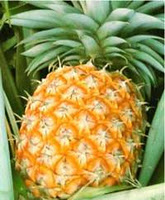
 Origin of the pineapple
The origins of the pineapple plant from tropical America, namely Brazil, Argentina and Peru. At this point, the pineapple has spread around the world, especially around the equator between 300 N and 300 LS. Nature Botany pineapple grass is very short petiole. Pineapple is a monocotyledonous plant, and is (shoots of young trees).
A. leaves and branch leaves are very long, veined, parallel, and spines on the edges grow upward (toward the tip of the leaf). To disappear in some varieties of pineapple, pear began, but the thorn at the tips of the leaves is often still visible. The leaves appear and accumulate at the base of the stem. On stems and flower stems grow shoots often grow. Suckers on the trunk, while the bud on the stems of the fruit is slippery.
b. The flowers bloom at the tips of pineapple plant stems and flowers only once in the direction perpendicular to the surface. In fact, pineapple and floral combination of more than 200 non-traditional flowers. Position of flowers sitting on the main stem of the fruit develops, and then a compound fruit is good to eat. Leaf sheath of each bud, known as the eye can still clearly left their mark on the fruit. Flowers are the perfect flower has three petals, three crowns, six stamens and three stamps with scars branched. Pineapple plants cross-pollinate with the teaching of singing birds and the bees. Pineapple crop is not seasonal, but can bloom at any time. However, there is a tendency to cold, especially at night with low temperatures, solar radiation, can promote the flowering of pineapple plants.
c. Fruit Pineapple is a fruit compound called sinkarpik or coenocarpium. The top of the fruit grows short leaves swirl like a crown-called (crown) is arranged.
D. Plant roots take deep fibers and contain little water. Pineapple roots flat and wide. Use fresh pineapple delicious eaten ripe and sweet, but some are sweet, sour taste. The fruit matures in the throat, itching due to high oxalic acid content. Ripe fruit can be made or beverage cans. The leaves can be processed into fibers (wire) is good for clothing. Substances in fruit brome lain, which is a solver of protein (meat tenderizer) include, but below the papaya diet proteolysis. The leaves have long fibers, but had not been used as clothing. Pineapple plants require Macroeconomic plains in the Highlands 1200 meters. These plants are not resistant to snow, but very resistant to drought. However, terrestrial plants prefer fertile, moist climate with a rainfall 1000-2500 mm per year. The cultures were resistant to acid soil, which has a pH of 3-5, but the best is Nature soils of pH 5 to 6.5. Therefore, the pineapple plants as well developed in peat lands. Pineapple plants are grown outdoors, but can grow up big tree shade. But in the open, which gets hot sun, the result is often lost. In areas dry winter (4-6 dry months), the plants were still able to pay off, provided that the water depths between 50-150cm land. This is due to shallow roots, but the system must be able to store water.
So far, the spread of plants, pineapple plants that had spread from the base of the trunk. But sometimes spread sucker also briefs and the crown. Trunk and crown of flowers can be cut and divided, which are used as seeds. Between seedlings, stems and buds of the Crown, there are differences in the physiological age of flowering and production. At the top of the plant, age, production costs and lowers longer. However, at the age of flowering plants no problem, because of the pineapple to grow flowering plants began to give substance that can be made between hard metal and Ethel 40 RMP. Fresh flowers crowns or plants are planted directly without first planted. However, it should be left for a few days before planting. This is a smooth closed the wound as quickly establish itself first. High-yielding varieties of high yielding varieties, which have not been released, but many varieties have been developed. The cultivation of pineapple plants with 2-2 developed an online system. Each line in a distance of 60 cm x 60 cm and 150 cm distance. However, pineapples are planted 30-40 cm, even remotely. The closest distance of the result, plus the fruit is produced. For the purposes of the canned fruit industry are generally small (a distance of 30 cm x 40 cm) cylindrical necessary.
The benefits of pineapple
the fruit contain nearly 90% of the water in it. With its abundance of potassium, calcium, odium, sulfur, chlorine, acid, biotin, vitamin B12, vitamin E and the enzyme brome lain. With abortion, so many turned out to be useful in treating the disease.
Supports digestion / wound
Pineapple fruit is rich in brome lain, an enzyme that useful for the throat and helps digestion. The enzyme brome lain digest protein in the food and prepare it to be easily absorbed by the body.Bromelain helps the healing and the / swelling inflammation in the body.
Strengthen the immune system
Pineapple is a nonessential amino acids and essential contribution to strengthening the body's immune system to overcome fatigue and improve endurance and energy. Valise and leonine substances in pineapple is also needed by our body for growth and repair of muscle tissue. This substance is one of the materials necessary to maintain the energy level of our body. On-essential amino acid compounds, praline, it is important to preserve the function of joints and tendons as well as strengthening the heart muscle. In addition, pineapple contains cosine, which is useful for the formation of skin and hair. Cosine also helps slow the aging process.
Decrease
Pineapple fruit was to streamline the body and is very good for a diet program. The trick is a fruit that is ripe pineapple, peeled not to give and to clean. Cut if necessary and then juice or grated, then hit the water. Juice drinks the water, without any mixture, does it twice a day.
There are more of the other benefits included in the pineapple. However, from its benefits, rather there was a side effect of this fruit. First, the pineapple abortive young or potentially as a drug that can stop the uterus. Second, the gastrointestinal tract, pineapples fermented into alcohol. This could result in a relapse of rheumatism and arthritis. And third, ripe pineapple contains blood sugar levels are quite high. Diabetics should not be excessive pineapple.
Pineapples have side effects
although the pineapple has many advantages, it turns out, there are also side effects from the pineapple when consumed excessively.
First interrupt the uterus. It's a myth that eating pineapple can cause the death of a young belly said. Some studies say young pineapple as a potential drug content. It is therefore recommended that pregnant women consume no more pineapple youth.
Second increase in blood sugar. Ripe pineapple, which contain a sugar content high enough shot. People with diabetes should not be excessive pineapple.
Third Cause of rheumatism. Some studies in the process of digestion pineapple, alcohol, fermentation can lead to arthritis. For patients with rheumatoid arthritis and inflammation it should limit their consumption of pineapple.


